

Huawei MediaPad M5 Pro vs. Apple iPad: A premium Android tablet takes on the leader - groutrumn1953

Michael Simon/IDG
When we're talking some tablets, there are basically two markets: Apple's iPads and everything other. But in the everything-else bucket, there are a couple of standouts, and the Huawei MediaPad M5 Professional is for sure unitary of them.
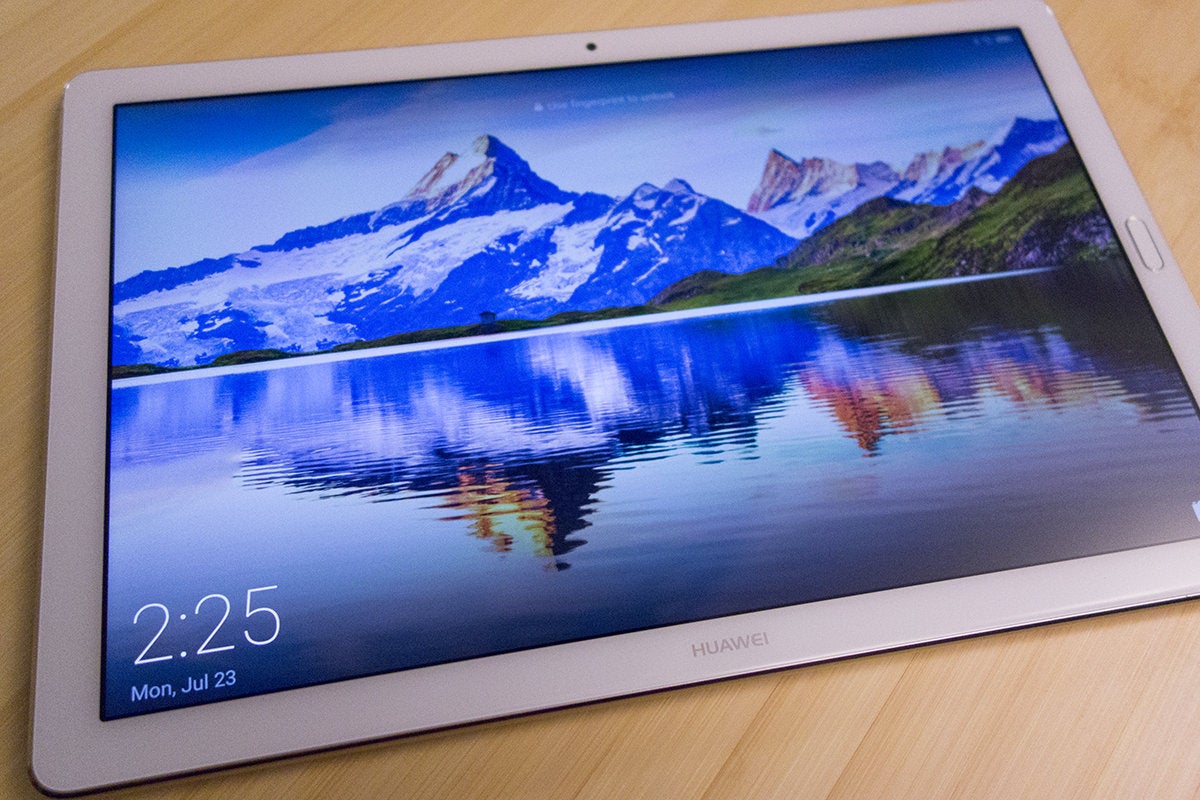
With a 10.8-inch silver screen, stylus support, and a Pogo pin connecter for attaching a keyboard along with a $449 price tag, Huawei is targeting some the 10.5-in iPad In favour of and the latest 9.7-in iPad with the MediaPad M5 Pro. So is this the cheap in favor tablet Mechanical man users have been wait for? Let's see how it slews up against Apple's newest tab.
 Michael Simon/IDG
 The screen, LTE support, and bundled M-Pen make the M5 Pro a fantastic apprais.
Let's start at the most important piece: the price. At first sight, IT seems like the 9.7-inch iPad is actually the better bargain:
- MediaPad M5 Pro: $449
- 9.7-inch iPad: $329
- 10.5-inch iPad Pro: $649
Simply there are some caveats. Huawei includes its M-Pen in the box, while Apple charges $99 for the Pencil. Also the MediaPad M5 Pro has support for LTE, which costs an additional $129 on the iPad. Then things change when you match the iPads to what's included with the M5 Affirmative:
- MediaPad M5 Pro (includes stylus and LTE backing): $449
- 9.7-inch iPad (adding $99 stylus and $129 LTE support): $558
- 10.5-inch iPad Pro (adding $99 stylus and $129 LTE support): $878
Plus the MediaPad has 64GB of computer memory—the same as you catch on the iPad In favor and twice that of the 9.7-inch iPad—along with a microSD time slot for expandable storehouse. Granted it might make up too more than pad of paper for some people, but if you need the LTE, memory board, and stylus, the MediaPad M5 In favor of is easily the better value. Winner: MediaPad M5 Favoring
 Michael Simon/IDG
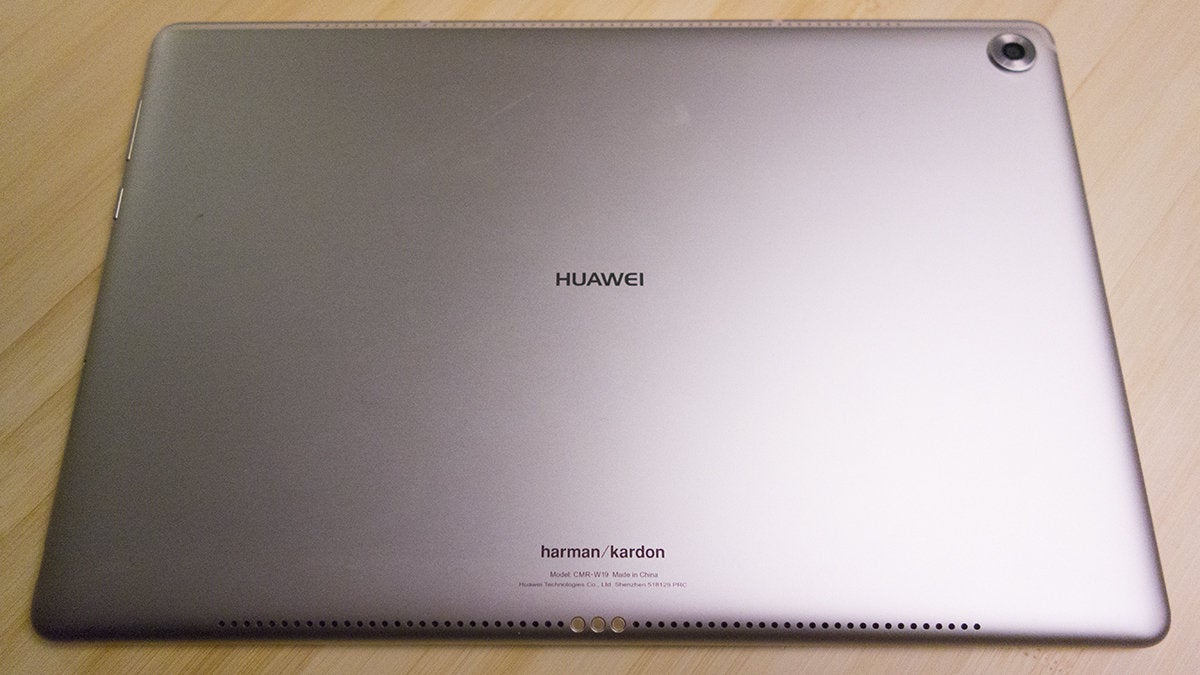
 The MediaPad has a fairly, nominal design with soft edges and smooth curves.
You don't need to be a tablet expert to see the most writ large difference betwixt the MediaPad M5 Pro and the iPad: their outer dimensions. While the 10.8-inch MediaPad M5 Pro has a screen that's nearly the selfsame oblique breadth as the 10.5-column inch expose on the iPad In favour of, the MediaPad show's ace-wide 16:9 aspect ratio and broader bezels make the tablet observably longer and narrower than the iPad, with its 4:3 display. Hera are their exact measurements:
- MediaPad M5 Pro: 274.3 x 171.8 x 7.4mm
- 9.7-in iPad: 240 x 169.5 x 7.5mm
- 10.5-edge iPad In favor of: 250.6 × 174.1 × 6.1 mm
Information technology's not merely that it's bigger. While information technology really looks and feels off the beaten track dilutant than it actually is, the MediaPad's elongated size makes it a bit awkward to use, particularly in portrait mode. When holding it in landscape mode, however, the 2.5D (sinuate-abut) glass and chamfered edges rest nicely in your hand. The MediaPad M5 Pro comes in one color scheme—gold with a Stanford White fore—where Apple offers many options, with silver, distance gray (with a black anterior) and rose metallic—but overall, Huawei has built a tablet that feels even as premium as the iPad.
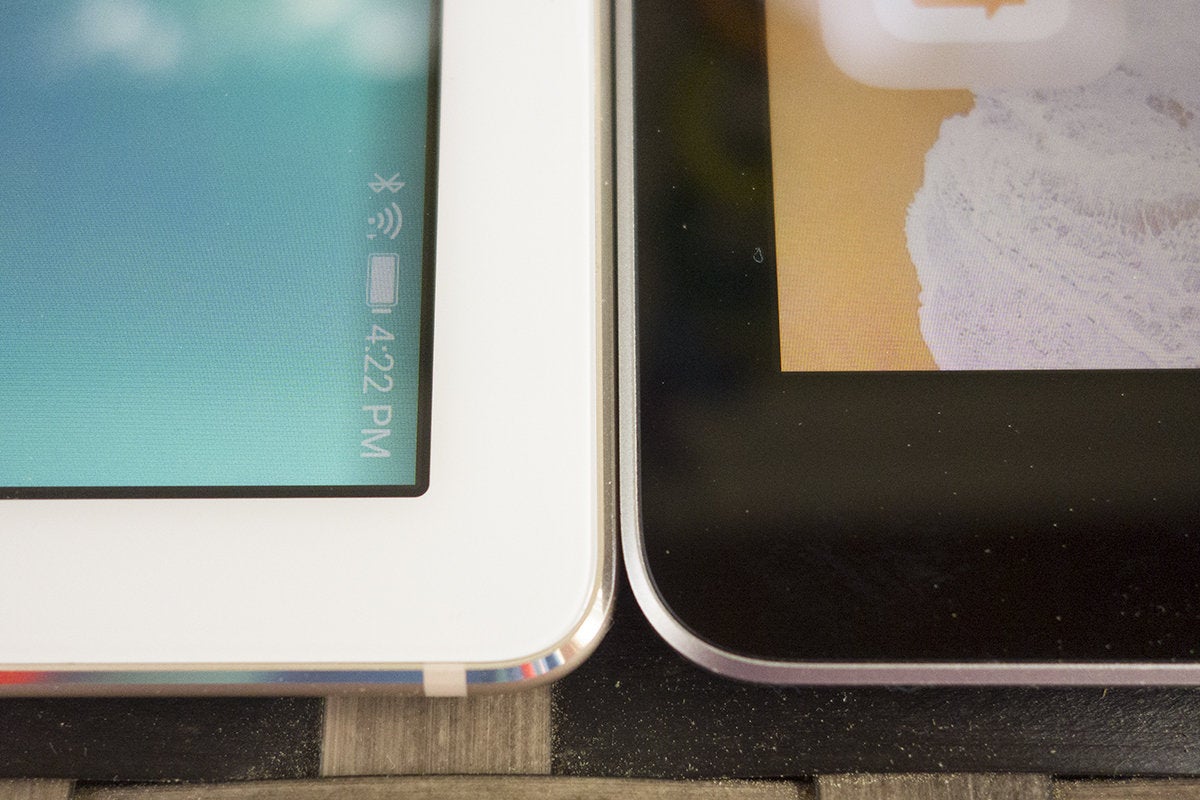
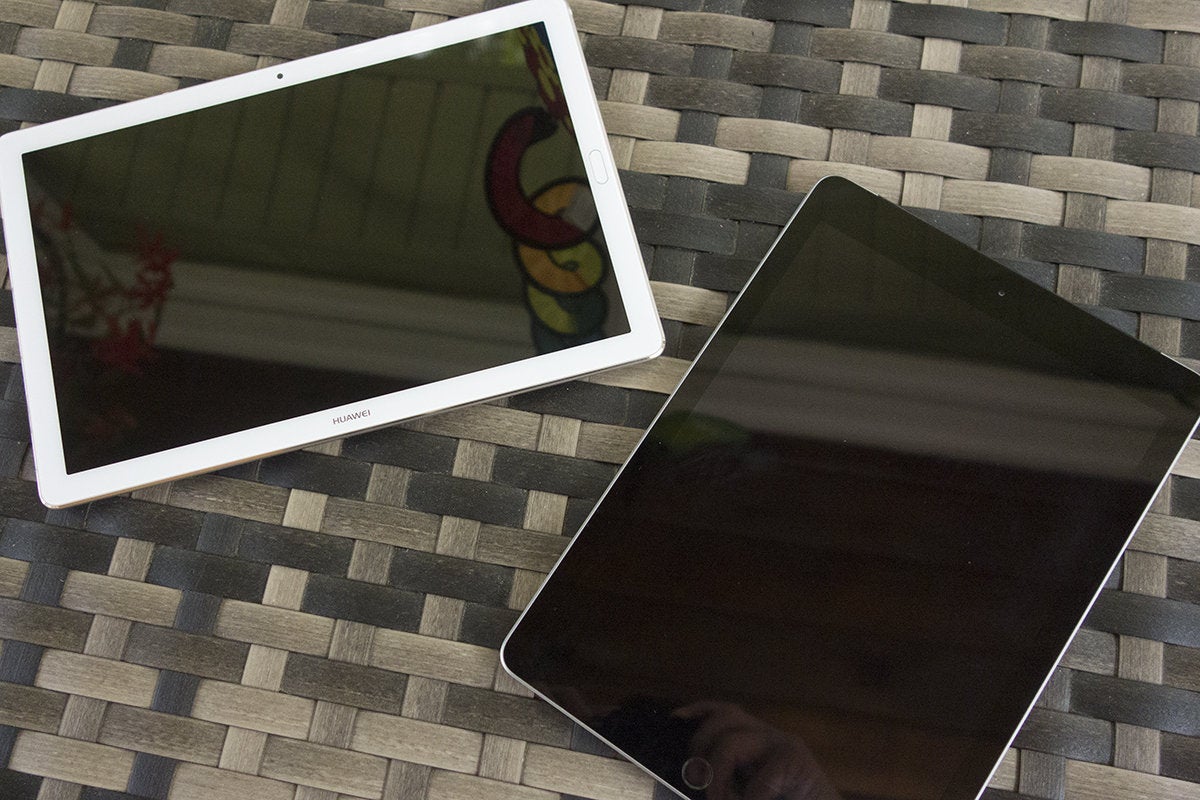
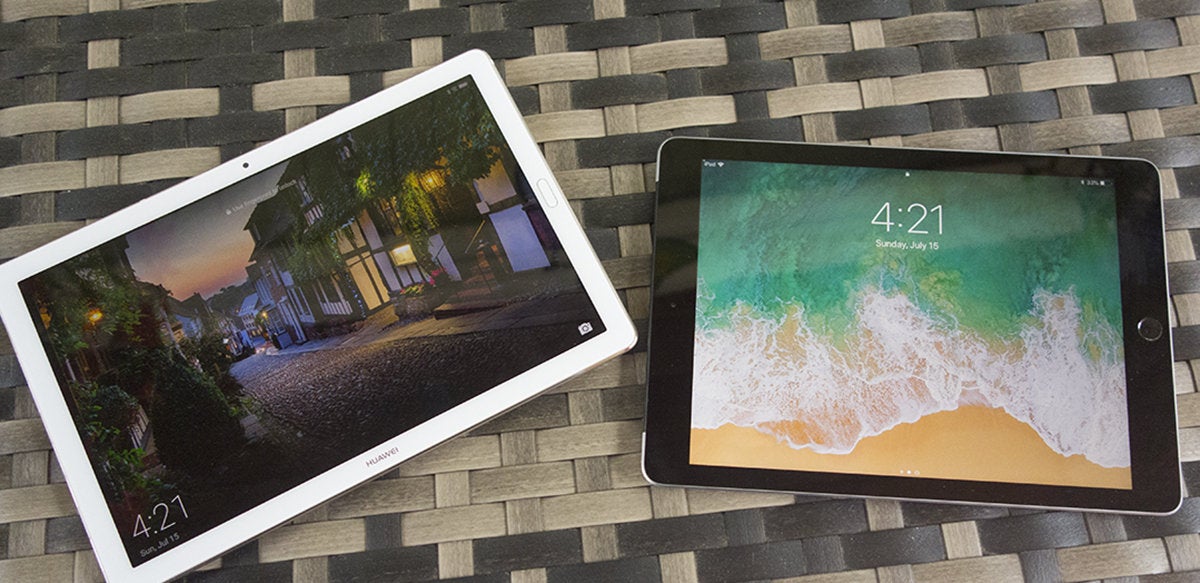
The bezel designs are also distinctive because of design choices. The iPad has a thick bottom bezel to accommodate its circular home release, but its side bezels are diluent. An oval-shaped interior button way the MediaPad M5 Pro can have a smaller chin than either iPad has. Huawei's decisiveness to make the bezels the same thickness, nevertheless, makes the pill look a little clunkier on the sides. It's a tradeoff that I didn't love (plus I could possess done without the Huawei logotype in the center of the pinch bezel).
 Michael Simon/IDG
 The chin happening the 9.7-edge iPad (right) is much bigger than it is on the MediaPad M5 Pro (socialist).
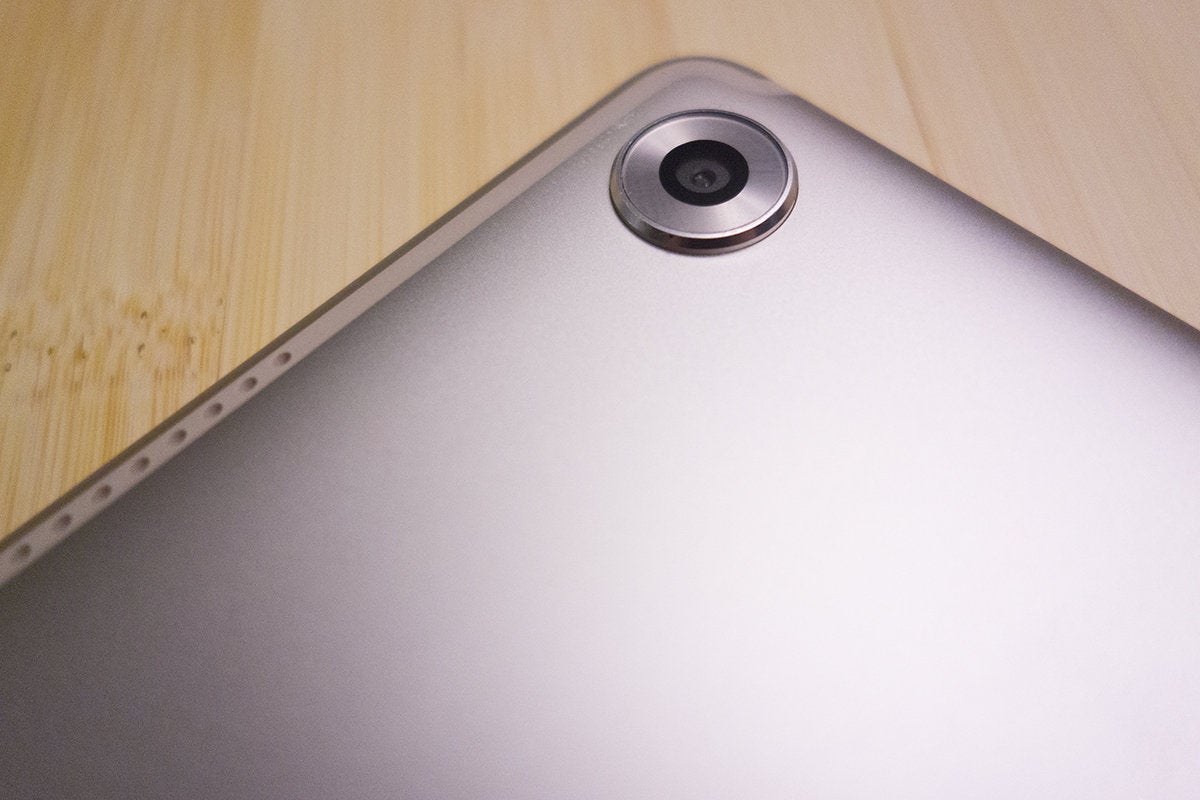
Around the backbone, the two tablets look strikingly similar, with some notable exceptions. Like the iPad, the MediaPad M5 Pro's back panel houses a 13MP television camera in the top opportune corner with a goodish bump off, while Apple's is on the left. Otherwise, the M5's back is precisely as clean American Samoa the iPad. A couple of polysyllabic grilles along the upmost and bottom edges house four speakers, similar to the iPad In favour of. At that place's no more headphone jack, but it comes with a USB-C-to-3.5mm adapter. The USB-C port is funnily positioned at the left of the edge below the rest home button, which is likewise where you'll find the power button and volume rocker, which take many acquiring accustomed. In contrast, Apple keeps it hastate with the 9.7-inch iPad: There's a Lightning port and loudspeaker grill on the can and a headphone jack at the top.
But the real difference is with orientation. While Apple's tablets skewed toward portrait modal value, the companionship's largely pleased to let the user decide which direction to oblige the iPad. Huawei, then again, clearly wants you to use the MediaPad M5 Professional in landscape mode. The home release might wave you to pick it up in portrait mode, everything other about IT is made for wide use, from the placement of the selfie camera and the logo, to the buttons and screen ratio. It's a discriminating design, but holding the M5 Pro in portrait modal value for any extended total of clock time is seriously clumsy. Victor: iPad
 Michael Simon/IDG
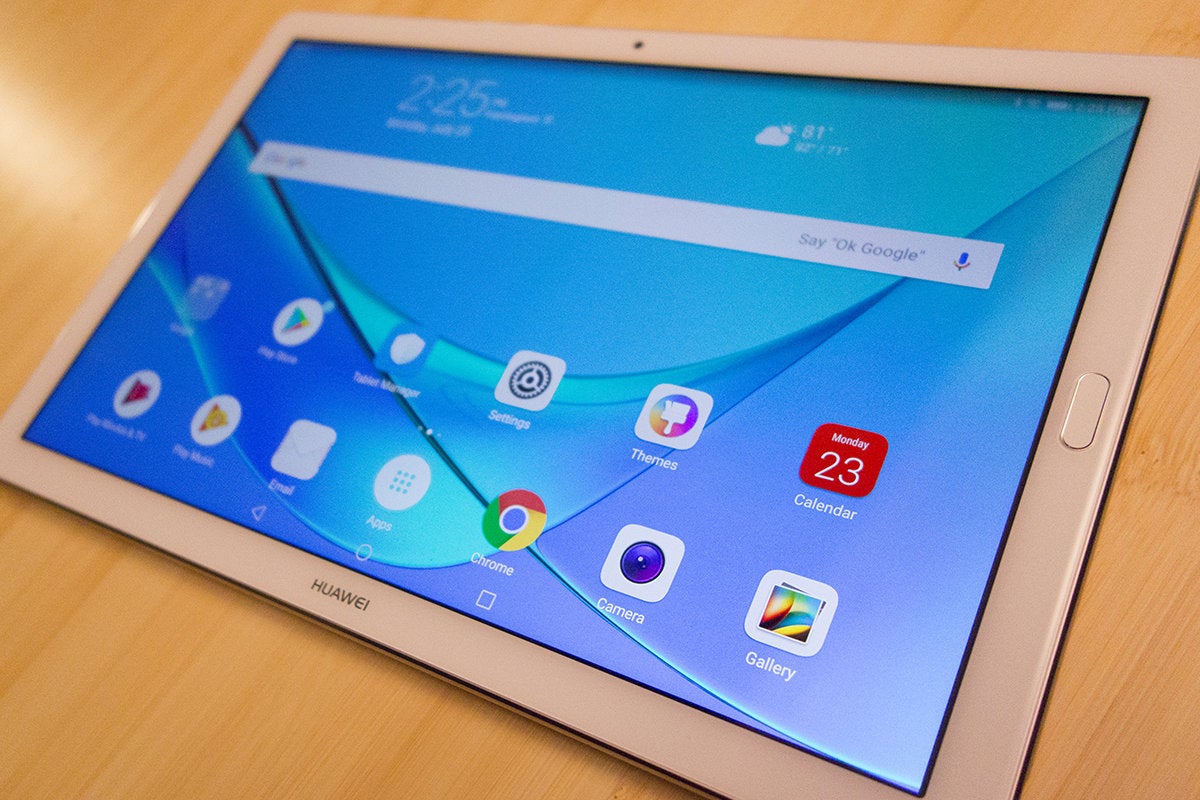
 The video display happening the MediaPad M5 Pro is wide and wonderful.
Despite the wider presentation on the MediaPad M5, both tablets stimulate similar Retina-estimable resolutions:
- MediaPad M5 Pro: 2560 x 1600
- 9.7-inch iPad: 2048 x 1536
The iPad and MediaPad M5 Pro both use IPS-like display technology, and it's hard to spot much of a difference between them. The iPad Pro's True Tone showing and ProMotion characteristic stand alone and add an extra element in certain lighting and situations, but when comparing information technology with the 9.7-column inch iPad, the overall clarity and brightness on the MediaPad is superior to my eyes. Colors popped without being oversaturated. Even at full brightness, I was able to function it for long amounts of time without straining my eyes. The blanket screen makes a real difference when watching movies. Winner: MediaPad M5 Pro
 Michael Simon/IDG
 Both tablets use plate-grown and home-optimized chips.
Some tablets use homegrown processors rather than Qualcomm's popular Snapdragon chips. The MediaPad M5 Pro gets a special "s" variant of Huawei's last-gen Kirin 960 octa-core chip. Curiously, IT's actually slower than the original chip at, running at 2,100MHz rather than 2,400MHz, so I shady the tweak has more to coif with power efficiency than operation.
As such, stamp battery life is also stellar. The MediaPad M5 Pro includes a massive 7,500mAh barrage that lasts for single years of perpendicular habit. Huawei rates it for 12 hours of 1080p video playback (ii hours longer than the 10-hour iPad), and you'll unquestionably be able to squeeze in a more after a heavy day of heavy solve. I systematically had more barrage fire left connected the MediaPad after performing two simultaneously draining tasks. More significantly, I didn't bump any of the tell-narration lag that so often afflicts Android tablets. If given the choice, I'd rather the MediaPad had used the Mate 10 Pro's Kirin 970 central processing unit, which brings AI processing and superior power efficiency, just the 960s seems more than capable of handling moderate tasks.
Apple's 9.7-inch iPad also runs a previous-propagation A10 Fusion chip, but the speed differences are minimal between it and the newer A10X Fusion chip in the iPad In favou. Thanks to iOS optimizations, apps and animations take flight on Apple's iPads long after their ledge liveliness has expired. It remains to be seen if Huawei's chip can stand skyward to years of use. Bench mark scores skewed heavily in party favour of the iPad, but out of the box, some are more than capable of handling a healthy dose of work and meet. Succeeder (performance): iPad Winner (battery): MediaPad M5 Pro
 Michael Marvin Neil Simon/IDG
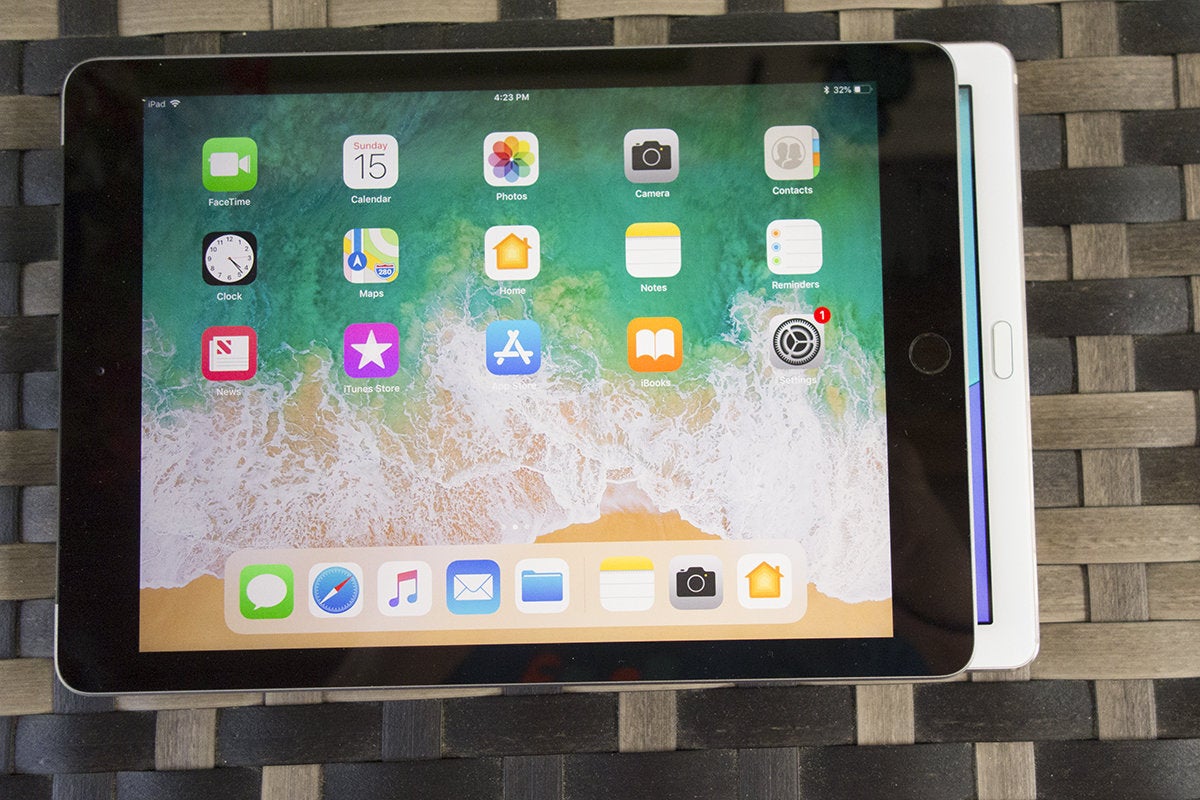
 The iPad's subroutine library of apps runs eclipses the offerings on Android.
The MediaPad M5 Pro runs an older version of Android Oreo cookie (8.0 quite than the newer 8.1), but you even so get the best features, including picture-in-picture and notification dots. Like its phones, Huawei skins Android with its own EMUI interface, merely it's much more palatable connected the big screen. There are a couple of bloatware apps (Booking.com, Facebook, etc.), extra Huawei apps (HiCare, Kids Corner), and unnecessary Android duplicates (Email, Gallery). Mostly, however. Huawei's Atomic number 76 is good suited for the larger screen. And like the Mate 10 Pro, the M5 has a fantastic curl screen that displays a rotating serial publication of beautiful images.
The bigger issue is the apps. While Apple's App Store is crammed with apps, games, and utilities that take wide-cut vantage of the iPad's enlarged screen in either orientation, Android developers have yet to fully bosom the tablet experience. As a result, most of the apps on the MediaPad M5 Pro feel like winded-unconscious phone apps rather than powerful pad ones. Even Google's apps are lacking the big-CRT screen polish of Apple's, and the experience suffers as a result.
Ane of the biggest reasons for Android tablets' struggles is that the OS ne'er embraced the possibilities, and that hasn't gotten any better with Oreo cookie. From the gestures to the multitasking, everything on the iPad feels more powerful and intuitive. Using it pull-by-incline with a 2018 Android tablet only highlights how off the beaten track behind Google's OS is. Succeeder: iPad
The pen is mighty! Read on for a comparison of the Apple Pencil and Huawei M-Pen styli, camera, and more.
 Michael Simon/IDG
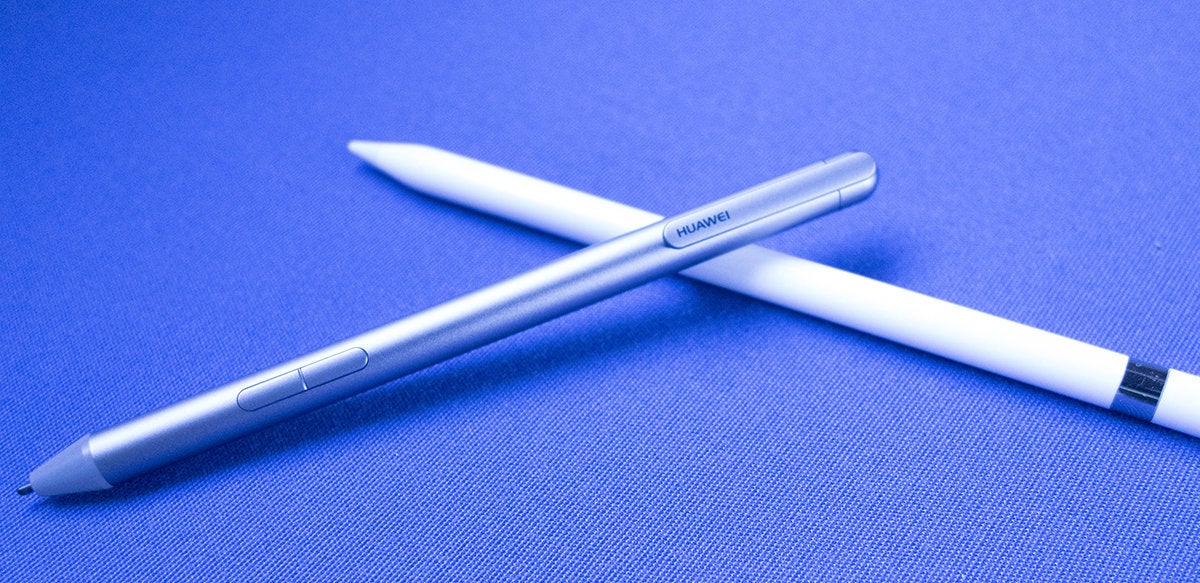
 Huawei's M-Pen (left) is a bit to a greater extent like a transitional penitentiary than the Apple Pencil (rightist).
The biggest selling betoken for every last of these tablets is plunk fo for an active stylus. While you preceptor't need a style to enjoy either twist, they in spades heighten the know.
The Apple Pencil and Huawei M-Pen are both powered styluses, which gives them unique abilities, but they run in diametric ways. Apple's Pencil is a Bluetooth device, so it needs to be paired to the iPad first, while Huawei's M-Pen has capabilities that work with the pill without pairing (principally, a button near the bottom will activate screenshot draft musical mode). Despite the extra step, Apple's method is remarkably quick, though, and merely requires plugging the Pencil into the iPad's Lightning port. Some devices let you use the stylus for basic sailing, though I preferred the softer tip of the M-Pen to Apple's more rigid Pencil.
When it comes to charging, both styli get on-device ports. The Pencil connects via Lighting cable to eviscerate power from the iPad itself (which is a teensy-weensy precarious) and the M-Penitentiary's USB-C port is tucked under its inherent clip. Neither has a power button. Huawei claims its pen lasts for a whopping 50 years, while the Pencil will need a charge afterwards about 12 hours. However, Apple's Pencil charges incredibly fast, taking just 15 seconds to slurp enough juice for 30 transactions of exercise.
Both styli are Charles Herbert Best suited for drafting rather than writing, and they perform well. Gliding either pen across the blind produces smooth lines with low latency. The M-Pen's 4096-level imperativeness sensitivity offers precise strokes and shadings.
It's hard to plunk a succeeder supported execution alone (especially because I'm not an artist). I somewhat preferred the size and weight happening the M-Pen, which is closer to a ballpoint pen's feel than Apple's somewhat elongated Pencil. Another M-Indite advantage is the MediaPad's bundled Nebo for Huawei app, which is a M-Pen-optimized version of its $6 Meet Storage and App Store note-taking app. The app is specifically built for stylus support, and its script recognition is surprisingly good. The experience is basically the Lapp as it is on the iPad, simply it's skillful not to have to pay up for it on the MediaPad. Victor: MediaPad M5 Pro
 Michael Simon/IDG
 The MediaPad M5's camera has a prominent bump.
Neither of these tablets will be spending much time in the camera app, merely the MediaPad M5 Pro's wider kind factor actually makes information technology a little easier to snap pics. The MediaPad also has the better camera in writing (13MP vs. 8MP along the iPad and 12MP on the iPad Pro), just your shots aren't going to win some awards. Basically pictures from all these tablets look like they were taken with 2014 phones, with fuzzy edges, terrible low-digestible graininess, and an general deficiency of sharpness.
Huawei's app is a little more robust than Apple's, with a set of manual controls and a cool undemanding-painting style that lets you make long-vulnerability effects. Simply that doesn't necessarily mean you'll take advisable shots. Given how stellar the cameras are on both the iPhone and Huawei's First mate 10 Pro, it's a bummer that their respective tablet cousins are then underwhelming in the photography department. The goodness news is you'll probably deliver a really good phone in your pocket when IT's time to take a see. Winner: None
 Michael Herbert A. Simon/IDG
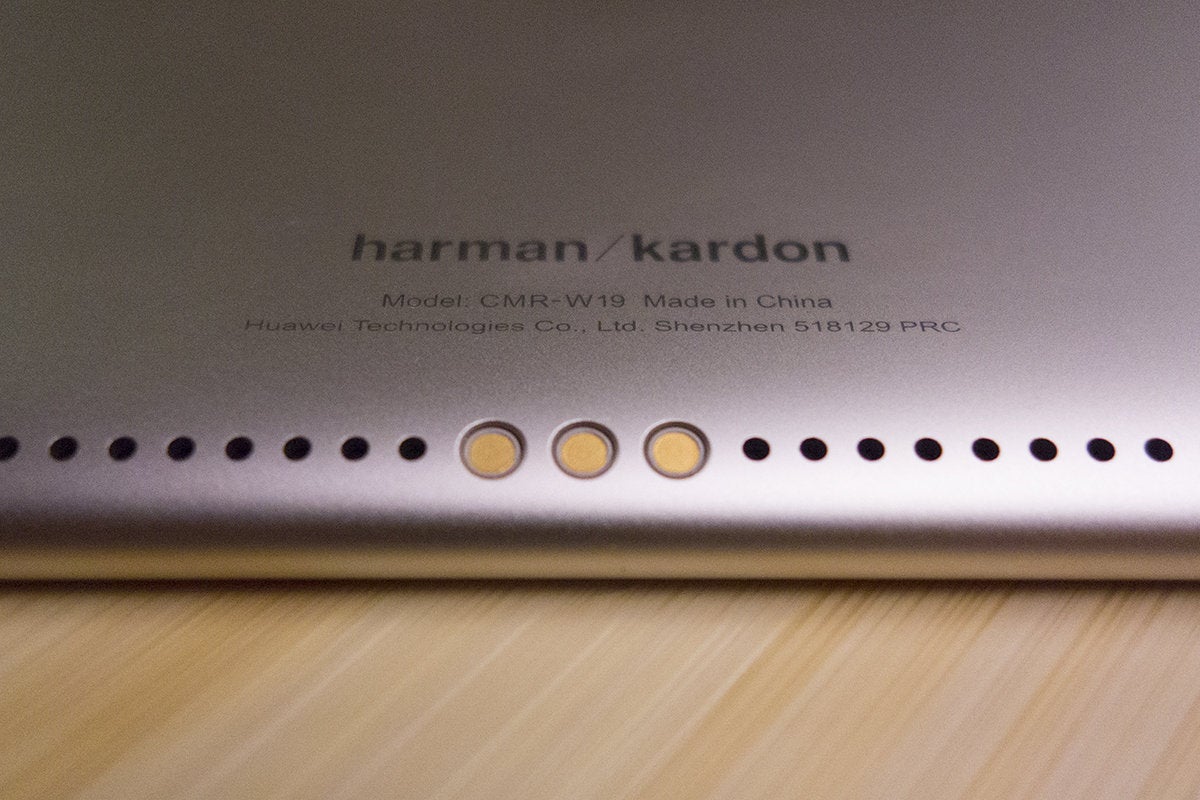
 A set of Pogo pins let you tie in an optional keyboard to the MediaPad M5 Pro.
While Huawei isn't running any snarky "What's a computer?" ads to promote the MediaPad M5 Pro, it intelligibly wants you at to the lowest degree to reckon using its tablet as a PC. A trio of Pogo pins lets you tie a keyboard, which Huawei sells separately, a feature reserved for the more expensive iPad Pro.
Pop a MediaPad M5 Pro into the keyboard and it'll instantaneously switch into PC Mode, turning the location screen into more of a background, with resizable windows and a dock. It's similar to what Huawei does with its Mate 10 Pro, but the MediaPad doesn't stick out USB-C-to-HDMI, so you can't expatiate the test with a monitor. It's odd that Huawei would limit point the feature to its phones—peculiarly because tablets are more designed for heavy work—only I guess it's configured to sell more keyboards. As such, it's still closer to a PC environment than anything you'll get with the iPad, which really only adds keyboard shortcuts when a Smart Keyboard is pledged.
When used as a straight tablet, both pass split-screen multitasking and picture-in-picture backup. The iPad has better app support and a slicker implementation total, merely both apps handle split-screen multitasking well. The iPad's app advantage is once again along display here, however, as there are more apps that are optimized for the multi-window view. Winner (with keyboard): Huawei MediaPad M5 Pro Victor (without keyboard): iPad
 Michael Simon/IDG
 There are real benefits to buying either tablet.
Patc the conclusion to steal an iPhone operating room an Android phone pretty much starts and ends at the ecosystem, it's less of an issue when buying a lozenge. Patc the iPhone-iPad continuity features are respectable, they'atomic number 75 non central to the experience. Android users can happily incorporate an iPad into their existing mobile workflow with things like Google apps and Dropbox.
But Huawei has made a strong reason to consider an Humanoid pad of paper. The stylus, display, and keyboard support are closer to Apple's iPad Pro than its $449 price tag would indicate, and its lymphoblast-like connectivity and specs are a steal for the Price. If Huawei added support for PC Mode with an USB-C-to-HDMI cable in a future update IT would sealing wax the deal.
For right away, the iPad's app endorse and Operating system swing the pendulum retributory a bit in its party favor, but I'm comfortable saying the Huawei MediaPad M5 Pro is single of the best tablets you can buy.
MediaPad M5 In favou
Note: When you buy something after clicking links in our articles, we may earn a small commissioning. Read our affiliate radio link policy for more inside information.
Michael Simon has been covering Apple since the iPod was the iWalk. His obsession with applied science goes back to his first PC—the IBM Thinkpad with the lift-finished keyboard for swapping out the beat back. Atomic number 2's ease waiting for that to get back modish tbh.
Source: https://www.pcworld.com/article/402317/huawei-mediapad-m5-pro-vs-apple-ipad.html
Posted by: groutrumn1953.blogspot.com
0 Response to "Huawei MediaPad M5 Pro vs. Apple iPad: A premium Android tablet takes on the leader - groutrumn1953"
Post a Comment